
2.1. Behaviour of individual animals: Insects – Ants
Behaviour of individual animals: Ants
- Ant Societies
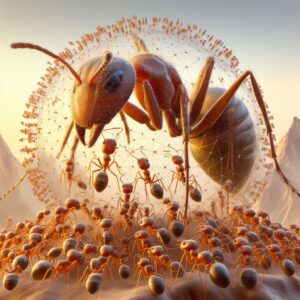
A. Life in a colony:
Life in an ant colony is fascinating! These societies are incredibly organized, with each ant having a specific role to play.
The queen is at the center of it all, laying eggs to populate the colony. Worker ants, who are sterile females, perform various tasks like foraging for food, caring for the young, expanding the colony, and defending it from threats. They communicate using pheromones and touch, signaling to each other about food sources or danger.
Ant colonies have complex underground networks of tunnels and chambers. The nests are meticulously maintained and ventilated. Some ants even cultivate fungus for food, while others “milk” aphids for their sugary secretions.
They have a division of labor based on age and need, where younger ants might take care of the larvae and older ones venture out foraging. Ants are resilient and adaptive; they can adjust to changing environments and work collectively to overcome challenges.
Their societies are a marvel of cooperation, coordination, and efficiency. Watching ants work together can be both impressive and thought-provoking.
The life cycle of Ants
B. Division of labour:
C. Foraging and Food findings:
D. Ants as Predators:
E. Pre defense:
F. Orientation and Migration:
G. Communication
Scientists have known for decades that ants use a variety of small chemicals known as pheromones to communicate. Perhaps the most classic example is the trail of pheromones the insects place as they walk. Those behind them follow this trail, leading to long lines of ants marching one by one. However, the insects also use pheromones to identify which nest an ant is from and its social status in that nest. Because this chemical communication is so prevalent and complex, researchers long believed that this was the primary way ants shared information. Ants also communicate to the individual of their species by tactile movement.
I. Courtship and mating:
Mating behaviors of ants fall into two categories: female calling, in which a female alate releases pheromones that attract males, and male swarming, in which large male aggregations attract females. Female calling is common in species with queens that return to their natal nest to found colonies dependently after mating, while male swarming is common in species with queens that disperse to found independently. In some species that display both founding strategies, a queen-size polymorphism has evolved in which dependent-founding queens are smaller than independent-founding queens. Dependent founding is likely difficult if gynes (virgin queens) are mating in distant swarms.
(Howard KJ, Kennedy D. Alternative mating behaviors of the queen polymorphic ant Temnothorax longispinosus. Naturwissenschaften. 2007 Nov;94(11):945-50. doi: 10.1007/s00114-007-0281-8. Epub 2007 Jul 25. PMID: 17653686.)
Video on Female calling
Video on Swarm and mating