
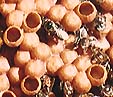
 pots are usually arranged in an irregular perimeter around a central brood comb that is constructed in horizontal layers.
Social caste is determined mostly by the diet an individual bee receives during larval development. Normally, workers feed their larvae royal jelly (a nutrient-rich glandular secretion) for the first few days and then switch to a less-nutritious diet of bee bread (a mixture of honey and pollen). Larvae destined to become queens, however, are reared in special (larger) brood cells and fed a diet of royal jelly throughout the entire duration of larval development. Males (drones) develop from unfertilized eggs. Their only function is to mate with virgin queens.
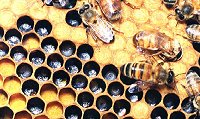 A queen controls the social organization within her colony by means of a pheromone secreted from her mandibular glands. Workers lick this pheromone from the queen’s body and pass it to nestmates during the exchange of food (trophallaxis). Queen pheromone maintains tranquility within the hive and inhibits ovarian development among workers. When the queen dies (or fails to perform adequately), she is replaced by a new queen reared from within the hive. Each colony, therefore, has the potential to be perennial, that is, to endure beyond the lifespan of the founding queen and her workers. Mature, healthy colonies may grow to include as many as 80,000 workers. However, before they reach this size, most large bee hives will “reproduce” by swarming. This is a process of colony division in which an established queen leaves (absconds) with a large group of workers to establish a new nest site, while a young queen and the remaining workers stay behind to occupy the old nest site.
Read 10 facts of Honey bees: