
2.5. Behaviour of individual animals: Mammals – Elephants
Elephants are the largest living land animals. Three living species are currently recognised: the African bush elephant, the African forest elephant, and the Asian elephant. They are the only surviving members of the family Elephantidae and the order Proboscidea; extinct relatives include mammoths and mastodons. Distinctive features of elephants include a long proboscis called a trunk, tusks, large ear flaps, pillar-like legs, and tough but sensitive grey skin. The trunk is prehensile, bringing food and water to the mouth and grasping objects. Tusks, which are derived from the incisor teeth, serve both as weapons and as tools for moving objects and digging. The large ear flaps assist in maintaining a constant body temperature as well as in communication. African elephants have larger ears and concave backs, whereas Asian elephants have smaller ears and convex or level backs.
Elephants are well-known for their intelligence, close family ties and social complexity, and they remember for years other individuals and places. They live in a fluid fission-fusion society with relationships radiating out from the mother-offspring bond through families, bond groups, clans, independent males and beyond to strangers.
Special relationships between individual elephants may last a lifetime, though the quality of these relationships and the structure and degree of cohesion in an individual’s social network may change through time.
Like many sexually dimorphic mammals, adult male and female elephants live in very different social worlds. A complex network of bonds between individuals and families characterizes the lives of females and their offspring, while fluctuating sexual cycles distinguish the dynamic activities and relationships of males.
Individuals, Personalities and relationships
Elephants have strong individual personalities that affect how they interact with other elephants, how others perceive them, and how well they are able to influence members of their group. For example, some elephants are popular while others are not. Some elephants show strong leadership qualities, others do not; some are highly social “extroverts”, while others are less social, “introverts.”
Elephant leadership – the Matriarch
No individual or individual personality has more impact on family structure and fortunes than the matriarch, or female leader, of an elephant family. Matriarchs are generally the oldest and largest adult female member of a family. In some cases it is very obvious who the leader of a family is – she is the individual to whom others orient, whose sudden change in activity they note, and whose leadership they turn to in a moment of crisis. In other families, the matriarch’s leadership is less clear, and in still others there may be conflict over who is the leader. The reasons for these differences have to do with personality, genetic relationships and history.
Matriarchs express their dominance in both competitive and cooperative situations. Matriarchs have been traditionally thought of as rather autocratic, making most decisions and leading a rather docile group of “followers.” While this may be the case in some populations and in some families, it has not been our observation. In general, we find that any member of a family may make a suggestion about a plan of action. Suggestions are typically made by adults, though on occasion even a juvenile may offer a suggestion.
Some elephants are natural born leaders and they begin to display their abilities at an early age. The most successful leaders seem to be confident, well-connected individuals who are able to command the respect of others both through their wisdom and charisma. A suggested plan of action by an individual may be ignored, discussed, negotiated, or simply followed without further ado. It is true that if a matriarch makes a suggestion there tends to be less discussion than if a suggestion is made by another member of the family – but even this does not always hold true. Very often the matriarch has to argue her case and in many instances she loses her argument to the combined will of other members of the family.
Qualities of a good matriarch
So, if the matriarch is not crucial in day-to-day decision-making, when is she important? Successful matriarchs are not self-appointed leaders of their family; they are leaders because members of their family respect them, and they are respected because they have proven over the years that they can be trusted to make wise decisions in a time of crisis. Through the years older females become “repositories” of social and ecological knowledge. So natural leadership qualities (personality) and long experience combined are the makings of a wise matriarch. Individuals living in families with older, more experienced matriarchs seem to gain more (in terms of survivorship) from her experience. However, not all matriarchs make wise decisions. Many families split up soon after the death of a matriarch and we believe that this may be partly related to conflict within the group over the new leader.
What are the qualities of a good matriarch? Why are some matriarchs able to hold their family together while under the leadership of others families fall apart? We do not have answers to these questions though we will hazard an educated guess. A successful matriarch needs to be both genetically and socially well connected to all members of her family. In essence this means that she must use her social skills to show compassion and care toward all members of her extended family (not just her own daughters). She must prove to the others that she is worthy of being their leader – by her display of courage and wisdom in times of crisis, by her awesome memory of places and individuals in tough or dangerous times, by her intricate use of tactics in socially difficult situations, and through her excellent social skills to regularly and consistently build, maintain and reinforce the close bonds within her family. In the end, however, when families become very large, and the costs of competition outweigh the benefits of cooperation, even the best matriarch may not be able to hold a family together.
Social Organization and Families
An elephant family consists of one or more usually related adult females and their immature offspring who feed, rest, move and interact in a coordinated manner and have close and friendly ties. Members of a family show extraordinary teamwork and are highly cooperative in group defense, resource acquisition, offspring care, and decision-making. Members of a family greet one another with a special “Greeting Ceremony.”  While cooperative behavior occurs most often between closely related individuals, kin selection does not explain all such behavior and a proportion of cooperative behavior within families can be explained by reciprocal altruism.
The intricate teamwork witnessed between members of an elephant family is to a large extent mediated by a complex suite of vocalizations. Day to day decision-making involves broad participation including consensus building. In Amboseli families contain anywhere from 2 to 16 adult females (that is, females over the age of 10). A matriarch, usually the oldest and most respected female, leads each family. Families may consist of as few as two or as many as 50 or more individuals.
The term “family” or “family unit” has meant different things to different people. Over more than three decades of observations in Amboseli we have witnessed the formation of new families and the dissolution of others. These changes occur over the course of many years as a complex network of relationships is built up or breaks down, and therefore it can be difficult to define at what point in time a particular group of individuals has become or ceased to be a family unit.
Bond Groups
Above the level of the family unit a second tier of relationships may exist within what is termed a bond group. Like the family, bond group membership is also usually determined by genetic relatedness. A bond group may include as many as five or more families, and up to 50 or more individuals. Although the ties between individuals across the bond group are weaker than those within a family, bond group members also have close and friendly ties, form alliances against aggressors, assist in the care of another’s offspring, defend one another in times of danger and greet one another in a special way.
Bond groups are usually formed as the bonds within a family weaken and families begin to split up along matrilines. In different habitats there exists an optimum family size where the benefits of group living outweigh the costs of competition for resources. As a threshold is reached and the costs begin to outweigh the benefits the family will begin to break up – especially during periods of low food availability. In Amboseli it appears that mothers, daughters and sisters are most likely to stay together, while the fissures tend to divide cousins.
The cohesion of different families and bond groups varies significantly and depends upon a number of factors, including personalities, the degree of relatedness and friendship between individuals, the strength of the matriarchs’ leadership, historical events such as deaths of important individuals, the type of habitat, and the season.
Clans
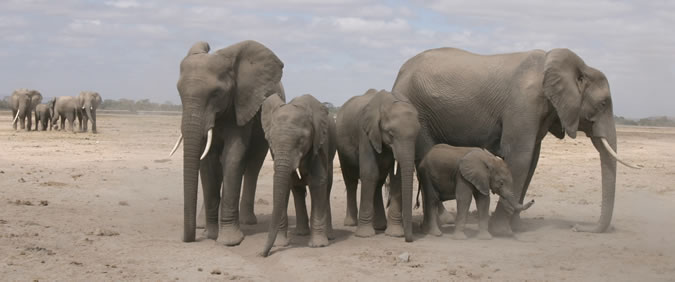
An elephant clan is the next social level and has been defined as those families who share the same dry season home range. These are elephants who share the same foraging areas when resources are in scarce supply. A clan is usually made up of several bond groups and numerous families such that several hundred elephants may make up a clan. Families tend to use their own clan area for foraging when times are hard, but during times of plenty they typically gather together in large social aggregations moving wherever there is good food available and a stimulating social life. In these aggregations several clans may intermingle. When resources allow, elephants will often choose to be in large aggregations, which frequently include several different clans. It is perhaps as a result of the positive experiences in these big social gatherings that some individuals decide to “move home” and establish residence and membership in a new clan.
Although clan membership is relatively static, over the course of four decades in Amboseli much has changed. While some elephants, like members of Echo’s family, are still using exactly the same home range as they were 35 years ago, other individuals have changed clans, changed bond groups and even changed families! Dramatic and dynamic changes have taken place in the lives of these individuals.

Males
Young male elephants grow up in the tightly bonded society of females and as calves and juveniles they maintain close relationships with their relatives and participate in the many social events that affect their family, albeit at a lower intensity than their female age-mates. Males depart from their natal family anywhere from 9 to 18 years of age – a process that can take anywhere from 1 to 4 years. 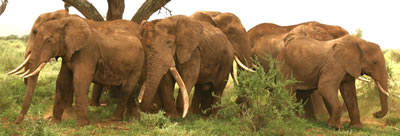 As a teenager a male elephant must learn a whole new set of rules based on his rank relative to each other male in the population, and his fluctuating sexual state. His transition from one society to the other changes gradually, but dramatically, over a period of eight or more years.
Independent males are often seen in small, all-male groups and they form lasting friendships with certain individuals, although these are looser arrangements than among female elephants. During sexually active periods males rove from one family group to the next in search of receptive females. Their interactions with family members are gentle and courteous, but rarely more. Once a male has located a receptive female he will, if he is competitively able, go into consort with her for a period of 2-3 days and then he will move on in search of another female.
Populations
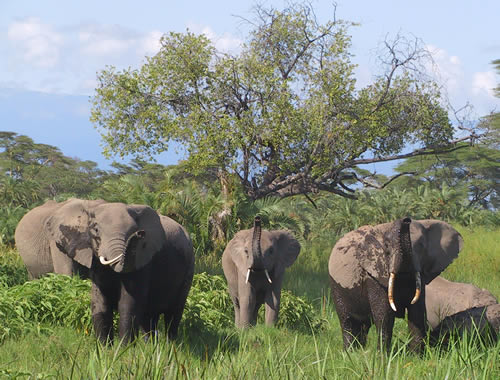 A population of elephants can be defined as a community of individuals linked by genetic and social relationships of mating and parenthood. For instance, the Amboseli elephant population utilizes a cross-border area of Kenya and Tanzania around the northern and northwestern side of Kilimanjaro. The Amboseli elephants interact with at least three different populations: The Kilimanjaro forest and Kitumbeini populations in Tanzania and the Tsavo population in Kenya. Between these populations there exists some gene flow, but this remains at very low levels.
The Kilimanjaro elephants come in small groups to visit Amboseli several times during the course of a year. Amboseli males mate with Kilimanjaro females, but the reverse rarely occurs as the Kilimanjaro males are smaller in body size and cannot compete with Amboseli males for access to females. We have evidence now that some of our males travel as far as the Kitumbeini area in Tanzania, a distance of over 100 km, and we know that a male who we believe originally came from Amboseli and is included in the Amboseli population records, travels well into the range of the Tsavo population, on the north eastern side of the Chyulu Hills.
Large Social Networks
The three elephant species, the African savanna elephant, Loxodonta africana, the African forest elephant, L. cyclotis, and the Asian elephant, Elephas maximus, are large brained, intelligent and highly social mammals. Exceptionally long lived, elephants live in a fluid fission-fusion society accumulating social and ecological knowledge over decades.
African savanna elephants typically live in larger family groups than either of the two other elephant species, and they are more often found in large aggregations. As a consequence, it is possible that the number, variety and complexity of their interactions and relationships may be even greater than the two other elephant species. In Amboseli a female elephant may physically encounter hundreds of other individuals in the course of her daily range. The individuals she meets will be related to her by different degrees, and known to her based on the frequency and the quality of their previous meetings and these factors will shape the nature and define the form of the relationship. An adult male, too, may meet and interact with hundreds of different individuals in the course of a day, though the type and nature of his relationships may be tempered by on his age and sexual state.
Some of the calls used by elephants are powerful low frequency vocalizations that carry over long distances. Elephant can recognize the voices of hundreds of other elephants from up to 2 kilometers away. Family members in particular have an extensive vocal repertoire and an unusually large communication network, a phenomenon that may be unique to long-lived mammals like elephants with fluid social systems, long-range signaling capacities and the mental capacity for extensive social recognition.

Sexual behaviour
Musth

Adult males enter a state of increased testosterone known as musth. In a population in southern India, males first enter musth at 15 years old, but it is not very intense until they are older than 25. At Amboseli, no bulls under 24 were found to be in musth, while half of those aged 25–35 and all those over 35 were. In some areas, there may be seasonal influences on the timing of musths. The main characteristic of a bull’s musth is a fluid discharged from the temporal gland that runs down the side of his face. Behaviours associated with musth include walking with a high and swinging head, nonsynchronous ear flapping, picking at the ground with the tusks, marking, rumbling, and urinating in the sheath. The length of this varies between males of different ages and conditions, lasting from days to months.
Males become extremely aggressive during musth. Size is the determining factor in agonistic encounters when the individuals have the same condition. In contests between musth and non-musth individuals, musth bulls win the majority of the time, even when the non-musth bull is larger. A male may stop showing signs of musth when he encounters a musth male of higher rank. Those of equal rank tend to avoid each other. Agonistic encounters typically consist of threat displays, chases, and minor sparring. Rarely do they full-on fight.
Mating

Elephants are polygynous breeders, and most copulations occur during rainfall. An oestrus cow uses pheromones in her urine and vaginal secretions to signal her readiness to mate. A bull will follow a potential mate and assess her condition with the flehmen response, which requires him to collect a chemical sample with his trunk and taste it with the vomeronasal organ at the roof of the mouth. The oestrous cycle of a cow lasts 14–16 weeks, with the follicular phase lasting 4–6 weeks and the luteal phase lasting 8–10 weeks. While most mammals have one surge of luteinizing hormone during the follicular phase, elephants have two. The first (or anovulatory) surge, appears to change the female’s scent, signaling to males that she is in heat, but ovulation does not occur until the second (or ovulatory) surge. Cows over 45–50 years of age are less fertile.