
Biogeographical Realm and Ecoregions
Biogeographic realm
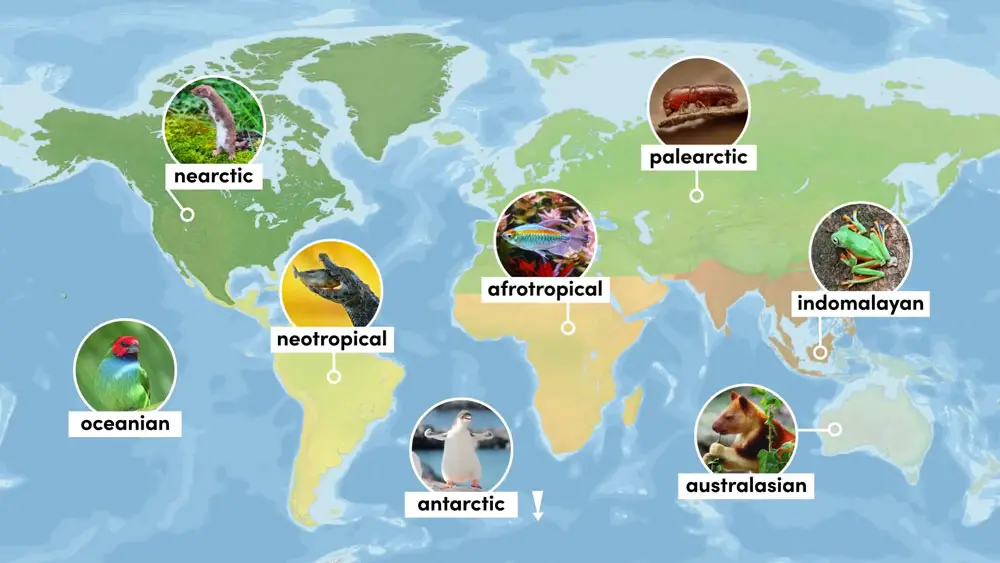
- Antarctic Realm
- Nearctic Realm
- Neotropical Realm
- Afrotropical Realm
- Palearctic Realm
- Indomalayan Realm
- Australasian Realm
- Oceanian Realm
Ecoregion
An ecoregion (ecological region) is an ecologically and geographically defined area that is smaller than a bioregion, which in turn is smaller than a biogeographic realm. Ecoregions cover relatively large areas of land or water, and contain characteristic, geographically distinct assemblages of natural communities and species. The biodiversity of flora, fauna and ecosystems that characterise an ecoregion tends to be distinct from that of other ecoregions. In theory, biodiversity or conservation ecoregions are relatively large areas of land or water where the probability of encountering different species and communities at any given point remains relatively constant, within an acceptable range of variation (largely undefined at this point). Ecoregions are also known as “ecozones” (“ecological zones”), although that term may also refer to biogeographic realms.
The intended purpose of ecoregion delineation may affect the method used. For example, the WWF ecoregions were developed to aid in biodiversity conservation planning, and place a greater emphasis than the Omernik or Bailey systems on floral and faunal differences between regions. The WWF classification defines an ecoregion as:
A large area of land or water that contains a geographically distinct assemblage of natural communities that:
- (a) Share a large majority of their species and ecological dynamics;
- (b) Share similar environmental conditions, and;
- (c) Interact ecologically in ways that are critical for their long-term persistence.
According to WWF, the boundaries of an ecoregion approximate the original extent of the natural communities prior to any major recent disruptions or changes. WWF has identified 867 terrestrial ecoregions, and approximately 450 freshwater ecoregions across the Earth.